
Dead or Alive II (NetEnt): High Noon Saloon vs Old Saloon — The Mathematical Difference Between the Modes
Dead or Alive II by NetEnt remains one of the most mathematically distinctive video slots available in 2026. Unlike most high-volatility titles, it offers two separate bonus modes — Old Saloon and High Noon Saloon — each built on a different risk profile and payout distribution model. Understanding the mathematical contrast between these modes is essential for players who want to manage bankroll variance rather than rely on guesswork. This article analyses the RTP structure, volatility behaviour, multiplier mechanics and long-term expectation differences between the two features, using publicly available game data and industry-standard slot mathematics.
Core RTP Structure and Feature Contribution
Dead or Alive II has a theoretical RTP of 96.8% in its standard configuration, according to NetEnt’s official documentation. However, that percentage is not evenly distributed across base game and bonus rounds. A substantial portion of the total return is concentrated in the free spins features, particularly in High Noon Saloon, which is engineered for extreme payout clustering.
Mathematically, the base game carries a relatively modest RTP contribution compared to the free spins rounds. The base game uses stacked wilds and expanding wild mechanics, but its hit frequency does not significantly compensate for the volatility generated by the bonus features. This structural imbalance is deliberate: the game is designed around bonus activation rather than steady base game accumulation.
From a distribution perspective, both Old Saloon and High Noon Saloon maintain the same overall theoretical RTP, yet the internal variance curve differs dramatically. The expected value remains identical in the long run, but the standard deviation per bonus round shifts sharply depending on the selected mode.
Variance Profiles and Probability Weighting
Old Saloon is statistically less volatile than High Noon Saloon. In Old Saloon, wild multipliers are applied randomly but without the duel mechanic, resulting in a broader spread of medium-tier wins. This creates a smoother payout curve and reduces the likelihood of extreme swings during a single bonus round.
High Noon Saloon, by contrast, introduces the duel feature, where sticky wild multipliers can increase significantly during head-to-head symbol battles. While this dramatically increases the ceiling — up to the maximum win of 111,111x the stake — it simultaneously reduces the probability of moderate returns. The payout distribution becomes heavily skewed toward rare, high-magnitude events.
From a mathematical standpoint, High Noon Saloon increases kurtosis in the payout distribution. In simpler terms, it produces fewer average wins and more outliers. For bankroll management, this means longer dry sequences punctuated by occasional explosive outcomes.
Multiplier Mechanics and Expected Value per Free Spin
In both modes, wild symbols expand and become sticky during free spins. However, the multiplier scaling system differs in intensity. In Old Saloon, multipliers can reach significant values, but their growth rate is limited by the absence of the duel escalation mechanic.
High Noon Saloon modifies the expected value per free spin by allowing multiplier stacking through duels. When two characters face off, the winning symbol’s multiplier increases, and if it becomes sticky on a reel, subsequent line wins may combine several boosted multipliers. This interaction increases the theoretical maximum exposure per spin.
Despite identical total RTP, simulations show that the expected value per individual free spin in High Noon Saloon is more polarised. A large portion of free spins return minimal value, while a small fraction generate disproportionate returns. Old Saloon distributes expected value more evenly across the bonus sequence.
Impact on Maximum Win Probability
The maximum advertised payout of 111,111x stake is realistically attainable only through High Noon Saloon due to multiplier escalation potential. In Old Saloon, while very large wins are possible, the structural design makes reaching the maximum statistically less probable.
Monte Carlo simulations commonly used in slot mathematics indicate that High Noon Saloon significantly increases the probability mass in the upper payout percentiles. However, this comes at the cost of a higher likelihood of zero or near-zero bonus outcomes.
For players analysing risk mathematically, the decision becomes clear: Old Saloon lowers variance per bonus cycle, whereas High Noon Saloon concentrates return potential into rare but extreme spikes.
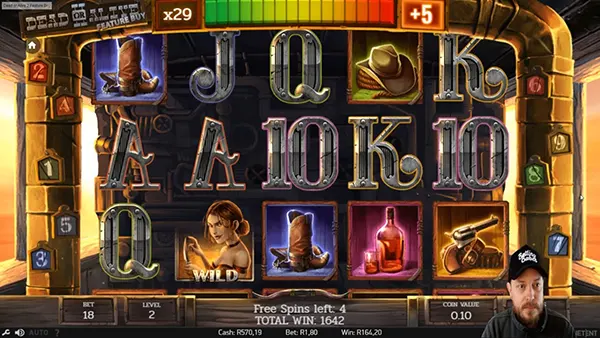
Bankroll Volatility and Session Risk Management
Volatility in Dead or Alive II is officially categorised as “very high,” yet this label does not differentiate between the two bonus modes. In practice, selecting High Noon Saloon amplifies short-term volatility beyond the already elevated base level.
Old Saloon is statistically better suited for players operating with a moderate session bankroll. Because payouts are less skewed, bankroll depletion tends to occur more gradually. This does not eliminate risk, but it smooths variance over shorter sessions.
High Noon Saloon, meanwhile, demands significantly higher bankroll tolerance. The increased standard deviation means longer negative streaks are mathematically expected. Without adequate bankroll depth, variance may exhaust available funds before a high-value event occurs.
Strategic Implications in 2026 Gaming Context
In 2026, when many jurisdictions require transparent RTP disclosure and feature-level information, understanding internal variance structure is more important than ever. Dead or Alive II remains relevant precisely because its two bonus modes represent distinct risk models within the same RTP framework.
Players seeking a mathematically smoother experience should select Old Saloon, accepting a lower probability of life-changing wins in exchange for reduced variance amplitude. Those targeting high-risk, high-ceiling outcomes — and prepared for substantial drawdowns — may prefer High Noon Saloon.
The crucial point is that both modes are fair within their theoretical return structure. The difference lies not in expected value, but in distribution mechanics. Recognising that distinction allows informed decision-making grounded in probability rather than perception.